Experience the Highest Rated Apostille Service in Westchester with White Plains Apostille
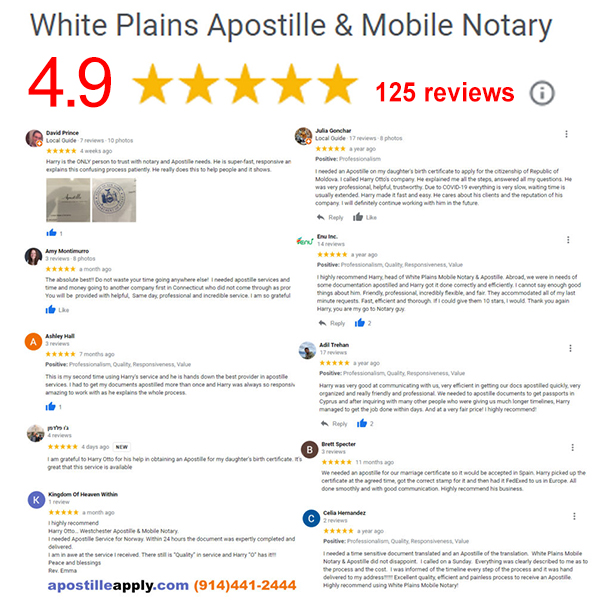
No other company processes more apostille documents or understands the complexities better than White Plains Apostille (also Corporate Apostilles). Don’t just take our word for it! Check out our amazing 5-star feedback on Bing, YelpPages, NiceLocal, Trustpilot and 5 stars from Chamber of Commerce. Our reviews reflect our unwavering commitment to providing excellent service to our customers and their documents.
At White Plains Apostille, we stand behind our “5-star Apostille submission guarantee” program. If a country rejects your apostilled documents, we will refile them at no additional charge. Achieving 100% customer satisfaction is our top priority.
Embracing Opportunities for Growth
We value Google reviews as a critical tool for identifying areas where we can improve to better serve our clients. While we strive for excellence, we understand that no business is perfect, which is why we openly acknowledge and embrace our 4.9/5 rating on Google reviews as an opportunity for growth.
One review, in particular, taught us a valuable lesson about the importance of transparent communication regarding our policies and procedures. The reviewer expressed frustration over a delay in receiving an urgent document due to a misunderstanding about overall payment requirements. Simply put, this reviewer had not paid for their order, nor intended to. We aim to provide the highest level of professionalism, and this experience highlighted the need for clearer explanations upfront. Authentication and apostille services through the New York State Department require payment before processing to ensure a seamless and efficient experience for our clients, much like ordering a product from companies like law firms, accounting firms, or even a local ride from Uber.
In this particular case, the reviewer had not completed payment for their order, which is required before we can process authentication and apostille services. While their experience highlighted room for improvement in our upfront communication about payment policies, we did not actually experience any misunderstanding – order policies were simply not followed.
Continual Improvement and Unparalleled Customer Service
At our core, we are committed to continual improvement and exceeding client expectations. We embrace feedback, even when it falls short of perfection, as a chance to enhance our processes and reinforce our dedication to unparalleled customer service.
Ask us about our “5 Star Submission Guarantee” that means “we will refile your documents at NO CHARGE if they are denied!” Inquire about our inexpensive document replacement insurance to replace your Apostille if it is lost, stolen, or destroyed. Did you know that even our Northern Westchester applicants can experience same day “in your hands” Apostille processing if your documents are in by 11 AM? So, if you’re in Dutchess, Rockland, Putnam, or Orange County, we have you covered!
New York Apostille Expediter Harry Otto has processed thousands of Procura Speciale and Generale Apostilles with every region of Italy and has engaged with hundreds of notaries all around Italy. He’s also notarized hundreds of Power of Attorney documents in New York and has dug deep into the similarities and differences between how New York and most of Italy regulate the creation and overall processes of these documents. Through his extensive experience, Harry Otto has gained invaluable insights into the intricacies of the Italian and New York legal systems concerning powers of attorney.
This article delves into the comparison between the New York Power of Attorney and its Italian counterparts, the “Procura Speciale” and “Procura Generale.” It explores the recent changes in New York Power of Attorney law, which went into effect on June 13, 2021, and how these changes compare to the Italian legal framework. The article examines the execution requirements, costs, and enforcement mechanisms in both jurisdictions, highlighting the key differences and similarities.
For legal professionals and businesspeople operating in both New York and Italy, understanding these differences is crucial. The article provides a comprehensive analysis of the principle of “parallelismo delle forme” and the need for “equivalenza” when dealing with foreign powers of attorney in Italy. It also discusses the role of the Apostille and the legalization process for countries not part of the Hague Convention.
Throughout the article, Italian legal terms and concepts are explained to educate New York lawyers about the Italian legal system. The article also incorporates New York case law, where applicable, to illustrate the practical implications of the power of attorney laws.
If you are a legal professional or a business person involved in cross-border transactions between New York and Italy, this article is an essential resource for understanding the complexities of powers of attorney in both jurisdictions. By reading this article, you will gain valuable insights into the differences in execution requirements, costs, and enforcement mechanisms, enabling you to navigate the legal landscapes of New York and Italy more effectively.
Comparing the New York Power of Attorney and the Italian “Procura Speciale”
The Power of Attorney (POA) is a legal document that allows an individual (the principal) to appoint another person (the agent or attorney-in-fact) to act on their behalf in various matters, including personal and financial affairs. In New York, the Statutory Short Form Power of Attorney is governed by Title 15 of Article 5 of the General Obligations Law. Similarly, in Italy, the “Procura Speciale” is a legal instrument that enables a principal to delegate specific powers to an agent for the completion of one or more legal acts.
Recent changes to the New York Power of Attorney law, which went into effect on June 13, 2021, aimed to simplify the POA form and reduce the frequency of refusal by financial institutions to honor validly executed POAs. These changes include:
Substantial compliance with statutory language, allowing for minor deviations in the POA form.
Elimination of the separate Statutory Gift Rider, with gifting provisions now included in the modifications section of the POA form.
Penalties for unreasonable refusal to accept a valid POA, including the award of damages and attorney’s fees.
A safe harbor for third parties acting in good faith when accepting a POA.
Execution requirements, including the need for the POA to be witnessed by two persons who are not named as agents or permissible recipients of gifts.
In contrast, the Italian “Procura Speciale” is governed by the Italian Civil Code (Codice Civile) and is subject to the principle of “parallelismo delle forme,” which requires the power of attorney to have the same form as the contract or legal act to be concluded. However, this principle is mitigated for powers of attorney originating from abroad by Article 60 of Law No. 218 of May 31, 1995, which states that the act of conferring the power of representation is valid, as to form, if it is considered as such by the law regulating its substance or by the law of the State in which it is executed.
For a foreign power of attorney to be equivalent to an Italian public deed (atto pubblico) or authenticated private agreement (scrittura privata autenticata), it must be substantially equivalent according to the notion understood by the Italian legal system, a principle defined by legal scholars as the need for “equivalenza” between the foreign act and the Italian act.
It is essential that the authority issuing the power of attorney has the power to perform notary-like functions. In countries where the notary figure is absent, such as Ireland, the United Kingdom, the United States, Australia, Canada, and Hong Kong, the role of the “public notary” exists, albeit with limited functions and responsibilities compared to Italian notaries.
Execution Requirements and Costs
Under the updated New York Power of Attorney law, a statutory short form power of attorney executed in New York must be typed or printed using legible letters no less than twelve points in size and signed, initialed, and dated by a principal with capacity, or in the name of such principal by another person, other than a person designated as the principal’s agent or successor agent, in the principal’s presence and at the principal’s direction. The signature must be duly notarized and acknowledged and witnessed by two persons who are not named in the instrument as agents or permissible recipients of gifts. The person who takes the acknowledgment may also serve as one of the witnesses.
In Italy, the identification of the parties (the principal and the agent) does not necessarily require all the elements prescribed by Italian notarial law (name and surname, place and date of birth, domicile, or residence). The indications required by the applicable foreign law for authentication will suffice, provided there is certainty about the subject’s identity. Importantly, the signature must be made in the presence of the person who will authenticate the signature.
The costs and fees associated with powers of attorney differ between New York and Italy. In New York, the cost of a POA varies depending on whether it is a general or special power of attorney and the services offered by the notary. A special power of attorney may have a lower cost than a general power of attorney, as it is not subject to registration with the tax authorities and is signed in a single original to be delivered by the notary to the party. Its overall cost consists of the stamp duty, archive tax, and notary’s fee.
In Italy, the costs and fees for a “Procura Speciale” are of significant importance, as Italian notaries yield much more power than their New York counterparts. The notary’s fee for each power of attorney is determined by the professional based on the complexity and preliminary activities to be carried out. A special power of attorney is subject to a €16 stamp duty (for powers of attorney up to 100 lines), while the costs for general powers of attorney vary depending on whether they must be registered in the Register of Enterprises (Registro delle Imprese).
Case law regarding the prior power of attorney law and gifting in New York remains in effect. Gifts of the principal’s assets must be in the best interest of the principal (In re Ferrara, 7 N.Y.3d 244 (2006)). Gifts made by an agent to themselves are valid if authorized by a specific provision in the power of attorney and made in the principal’s best interest, with no presumption of impropriety and the burden of proof on the person challenging the gift (In re Ferrara, 7 N.Y.3d 244). A gifting provision is not necessary when there is clear and convincing evidence that a transfer was compensation for services (Alsante v. Maika, 206 A.D.3d 1563 (4th Dep’t 2022)).
Enforcement and Recognition of Foreign Powers of Attorney
One of the most significant changes to the New York Power of Attorney law concerns the enforcement of POAs. If a special proceeding authorized by GOL Section 5-1510 is brought to compel a third party to honor the Statutory Short Form Power of Attorney, the court may award damages, including reasonable attorney’s fees and costs, if it finds that the third party acted unreasonably in refusing to honor the agent’s authority (GOL Section 5-1510(2)(a)). No third party can refuse, without reasonable cause, to honor a properly executed statutory short form power of attorney or one executed in accordance with the laws in effect at the time of its execution (GOL Section 5-1504(5)). This provision effectively grandfathers, for enforcement purposes, any properly executed Statutory Short Form Power of Attorney under previous statutes.
In Italy, the Hague Convention of October 5, 1961, introduced the Apostille, which verifies the authenticity of the signature and the capacity of the signatory of the act, constituting an attestation of the origin of its signature. This process simplifies the immediate reception of the document in the States adhering to the Convention. The Convention has established a standard formula and content for the Apostille, as well as a uniform graphic structure, requiring it to be inserted in a box with progressive numbering of the text lines. Regarding language, the Apostille does not need to be translated and can be written in French or the official language of the issuing authority, with the heading “Apostille” always included.
For countries not part of the Hague Convention, the process of legalization is followed, consisting of an official attestation by the Italian consular or diplomatic authority abroad of the legal qualification of the public official who signed the act and the authenticity of their signature. This process is divided into two distinct moments:
The so-called “internal” legalization, which is purely eventual and may not even be provided for by the legislation of a particular State.
The so-called “external” legalization, in which the Italian diplomatic or consular authority verifies that the document has been signed by a specific authority of the country of origin. This legalization is indispensable for allowing the document to circulate in Italy.
In conclusion, while both New York and Italy have legal instruments that allow principals to delegate authority to agents through powers of attorney, there are significant differences in the execution requirements, costs, and enforcement mechanisms. The recent changes to the New York Power of Attorney law have aimed to simplify the process and provide greater protection for principals, while the Italian “Procura Speciale” is subject to the principle of “parallelismo delle forme” and the need for “equivalenza” when dealing with foreign powers of attorney. Understanding these differences is crucial for legal professionals and businesspeople operating in both jurisdictions.
This article was researched and written by New York Apostille Expediter Harry Otto, All Rights Reserved. For more information call, text or WhatsApp White Plains Apostille & Mobile Notary at (914)441-2444 or begin your Apostille at apostilleapply.com
International Service Process Made Simple with White Plains Apostille & Mobile Notary
Are you navigating the complex world of international service process? Look no further than White Plains Apostille & Mobile Notary, your one-stop solution for seamless document authentication, apostille, and service abroad.
Same-Day Authentication and Apostille We expedite your documents with the New York Department of State, ensuring same-day authentication and apostille services. Our efficiency keeps your international legal matters moving forward without delay.
Expert Handling of Hague Convention and Inter-American Convention Processes – We specialize in both:
Hague Convention on the Service Abroad of Judicial and Extrajudicial Documents in Civil or Commercial Matters
Inter-American Convention on Letters Rogatory and Additional Protocol
Understanding the Difference:
Hague Convention: Streamlines service process between signatory countries, offering a more direct route for document delivery.
Inter-American Convention: Provides a framework for service among American nations, with specific procedures for Letters Rogatory.
Why choose White Plains Apostille? We navigate these complex international agreements so you don’t have to, ensuring your documents reach the right authorities efficiently.
Comprehensive Services:
On-site notarization
Authentication, Attestation, and Apostille arrangements
Professional document translation
Seamless processing and forwarding to U.S. Department of Justice contractors (e.g., Process Forwarding International)
Direct transmission to receiving country’s Central Authority
Stay Informed: White Plains Apostille provides regular updates on your document’s journey through the international legal system, offering peace of mind and transparency.
Why Outsource to Experts? International service process is intricate. Mistakes can lead to costly delays or case dismissals. Our expertise ensures your documents meet all requirements, saving you time, money, and stress.
Corporate Clients and Law Firms: Streamline your international cases with our tailored services. We understand the urgency and precision required in cross-border litigation.
Top 25 Countries for International Service Process:
Canada
Mexico
United Kingdom
Germany
France
China
Japan
Brazil
Australia
India
Spain
Italy
Netherlands
South Korea
Switzerland
Russia
United Arab Emirates
Singapore
Argentina
Saudi Arabia
Sweden
Turkey
Poland
Belgium
Ireland
25 Common Document Types We Handle:
Summons and Complaints
Subpoenas
Court Orders
Judgments
Divorce Papers
Child Custody Documents
Commercial Contracts
Corporate Documents
Trademark and Patent Filings
Affidavits and Declarations
Powers of Attorney
Birth Certificates
Marriage Certificates
Death Certificates
Academic Transcripts and Diplomas
Medical Records
Adoption Papers
Property Deeds
Articles of Incorporation
LLC Formation Documents
Wills and Trusts
Employment Contracts
Tax Documents
Insurance Policies
Extradition Requests
From serving legal documents in bustling Toronto to authenticating corporate contracts for use in Dubai, our expert team at White Plains Apostille & Mobile Notary ensures your documents meet all international requirements.
Don’t leave your international service process to chance. Trust White Plains Apostille & Mobile Notary to handle every detail with precision and expertise.
Take Action Now:
Call, Text, or WhatsApp us at (914) 441-2444 for immediate assistance.
Submit copies of your documents for review at apostilleapply.com.
Our apostille expediters will immediately review your requirements and provide a list of options and timelines tailored to your needs.
Contact us today to expedite your international service process and ensure your documents reach their destination efficiently and legally.
Keywords: International Service Process, Hague Convention, Inter-American Convention, Apostille, Authentication, Notary Services, Document Translation, Legal Document Processing, Cross-Border Litigation, White Plains, New York, Corporate Legal Services, Law Firm Support, International Judicial Access, Same-Day Apostille, Mobile Notary, International Document Service, Global Legal Processing, Cross-Border Document Authentication, Multinational Legal Support, International Subpoena Service, Global Summons Delivery, Worldwide Court Order Processing, International Divorce Document Handling, Global Child Custody Document Service, Cross-Border Commercial Contract Authentication, International Power of Attorney, Global Birth Certificate Apostille, Worldwide Marriage Certificate Authentication, Cross-Border Death Certificate Processing, International Academic Transcript Verification, Global Medical Record Authentication, Multinational Adoption Paper Processing, International Property Deed Authentication, Global Articles of Incorporation Service, Worldwide LLC Formation Document Handling
Streamlined Apostille Services in NYC and Beyond – White Plains Apostille
In today’s globally connected world, the need for properly authenticated documents has never been greater. From birth certificates and marriage licenses to corporate records and academic transcripts, having these vital documents apostilled is crucial for ensuring they are recognized internationally.
This is where White Plains Apostille comes in. Led by seasoned expediter Harry Otto, this New York-based firm specializes in providing rapid and reliable apostille services for clients across the state.
What is an Apostille? An apostille is a form of certification that verifies the origin and authenticity of a public document. It is required for official documents to be legally accepted in countries that are members of the Hague Apostille Convention. In New York, the Department of State Apostille office is responsible for issuing these certifications.
The Challenges of Obtaining an Apostille Navigating the apostille process can be a complicated and time-consuming endeavor, especially if you’re unfamiliar with the requirements. From gathering the necessary documents to submitting them through the proper channels, the process can quickly become overwhelming.
This is where White Plains Apostille shines. With a deep understanding of the apostille system and years of experience, their team is adept at streamlining the entire process, saving you valuable time and effort.
Expedited Services for Your Convenience Whether you need a document apostilled the same day, next day, or within 5 business days, White Plains Apostille offers a range of expedited service options to suit your specific needs. Their expertise extends to apostille services for clients in Westchester, Rockland, Putnam, and all five boroughs of New York City.
“We understand that time is of the essence when it comes to obtaining an apostille,” says Otto. “Our expedited services ensure that our clients can navigate the process smoothly, without unnecessary delays or headaches.”
A Comprehensive Range of Apostille Services At White Plains Apostille, their team is well-versed in handling apostille requests for a wide variety of documents, including but not limited to:
Birth certificates
Marriage licenses and certificates
Diplomas and academic transcripts
Corporate records and business documents
Passport applications
FBI background checks and fingerprint certifications
Translations and language certifications
Whether you’re an individual planning an international move, a business conducting transactions across borders, or simply need a document authenticated for use abroad, White Plains Apostille has the experience and resources to ensure your documents are properly certified and accepted.
Reliable and Trustworthy Apostille Experts With a commitment to exceptional service and a track record of success, White Plains Apostille has established itself as a trusted partner for apostille services in New York. Their team of professionals is dedicated to guiding you through the process, answering any questions you may have, and ensuring your documents are handled with the utmost care and efficiency.
If you’re in need of apostille services in New York, look no further than White Plains Apostille. Contact them today to learn more about their expedited options and experience the convenience of streamlined document authentication.
When it comes to creating a valid will in New York State, many of our callers wonder if it is always necessary to have two witnesses present. The answer is not as straightforward as one might think, as there are certain exceptions to the witness requirement.
In this article, we will explore the legal intricacies surrounding the necessity of witnesses for wills in New York, with a particular focus on the validity of handwritten wills.
The General Rule: Two Witnesses Required For a typical typewritten or printed will in New York, the law requires the presence of at least two attesting witnesses (EPTL § 3-2.1(a)(4)). These witnesses must, within a thirty-day period, attest to the testator’s signature and, at the request of the testator, sign their names and affix their residence addresses at the end of the will (EPTL § 3-2.1(a)(4)). The testator must also declare to each of the attesting witnesses that the document is their will (EPTL § 3-2.1(a)(3)).
The Exception: Handwritten Wills However, there is an important exception to the witness requirement in New York State. According to EPTL § 3-2.2(a)(2), a handwritten will, also known as a holographic will, is valid without the need for attesting witnesses. For a holographic will to be considered valid, it must meet the following criteria:
The entire will must be in the handwriting of the testator (EPTL § 3-2.2(a)(2)).
The will must be signed by the testator at the end (EPTL § 3-2.2(a)(1)).
The testator must have the mental capacity to make a will at the time it is written (EPTL § 3-1.1).
While witnesses are not legally required for a handwritten will, it is still advisable to have at least two individuals witness the signing of the document. This can provide additional evidence of the will’s authenticity and help prevent potential challenges to its validity (Matter of Teubert, 53 A.D.2d 869 (1976)).
The Option of Notarization for Witnesses Although not a legal requirement, if a testator opts to have two witnesses sign their handwritten will, a notary can acknowledge the witnesses’ signatures up to thirty days after they have signed, as long as the witnesses attest to having previously signed the will (EPTL § 3-2.1(a)(4)). This provides flexibility in the witnessing process and allows for the notarization of the witnesses’ signatures to occur at a later date. It is important to note that there is no provision in the EPTL for notarization of the testator’s signature on a will.
The “Importance of Proper Execution”, says Harry Otto, an apostille expediter and notary public at White Plains Apostille & Mobile Notary, often arrives at appointments for Last Will & Testaments in Westchester County and has to make judgment calls on what he’s willing to notarize and what he’s not. He makes it crystal clear: If he sees a will that is likely to get challenged in probate because the testator asked him to notarize their signature, and not those of the witnesses, he won’t do it because it will not create the self-proving aspect that the court would be looking for. If he sees mistakes in the document or in the request, he won’t offer legal advice, but he won’t notarize it and will ask the client to find another notary. It is crucial to ensure that a will is executed correctly to avoid potential issues during the probate process.
Harry Otto then goes on to say that although he lives and breathes this business and reads case law as a hobby, his main business is acting as an Apostille expediter, not an attorney, and especially not an estate planning attorney. He advises clients to pay for a consultation with an estate planning attorney, not a general practitioner, to get the right legal information. If it were up to him, everyone would have properly drafted trusts.
Conclusion In summary, while New York law generally requires two witnesses for a will to be valid, there is a notable exception for handwritten wills. A holographic will, entirely in the testator’s handwriting and signed by them, is considered valid without the need for attesting witnesses. However, it is still recommended to have witnesses involved to strengthen the will’s authenticity and minimize the risk of future legal challenges. If witnesses are used, a notary can acknowledge their signatures up to thirty days after they have signed. Proper execution of the will is essential to ensure its validity and to avoid complications during probate.
See our information regarding Trusts in New York as well.
Amanda Reese White Plains Apostille & Mobile Notary